
Home > Advisor Marketing Tips > SEO & AI Search: Getting Found
PILLAR GUIDE 2 OF 4
Financial Advisor SEO and AI Search: How to Get Found
Financial advisor SEO, short for search engine optimization, is the work of making your firm easy to find and easy to trust on Google, on the map and inside AI assistants such as ChatGPT. Some firms call it wealth management SEO, but the work is the same for a solo planner and a ten-advisor RIA.
Prospects start in more than one place. In Wealthtender's 2025 survey of 500 U.S. adults from households earning over $100,000 who plan to hire an advisor, 62% named friends and family, 49.8% a search engine and 25% an AI tool such as ChatGPT or Gemini, and respondents could name more than one. In Ficomm Partners' 2026 survey of 1,000 high-net-worth investors who already work with an advisor, nearly 9% had used an AI tool in their search. Advisor practice has not caught up: in Kitces Research's 2026 Advisor Marketing Study, 32% of advisors used SEO at $0.45 of marketing cost per $1 of new revenue, while 10% used answer engine optimization (AEO) at $3.45.
This guide has four parts, in the order a prospect meets them. Search covers Google's results. Map covers local results. Answer covers AI assistants. Prove covers what each one costs and returns.
By Simona Ondrejkova, CFP® · Updated October 30, 2026 · 13 min read
In this guide
Key takeaways
Keep SEO as the base. SEO cost $0.45 per $1 of new revenue and AEO cost $3.45 in Kitces Research's 2026 study of 506 advisors.
Ranking alone no longer wins citations. Ahrefs found 38% of AI Overview citations came from top-10 pages in March 2026, down from 76% in July 2025.
Plans run ahead of behavior. 25% of prospects in households earning over $100,000 said they plan to start with an AI tool (Wealthtender, 2025), while nearly 9% of high-net-worth investors who work with an advisor had used one (Ficomm Partners, 2026).
SEARCH
Does SEO Still Matter for Financial Advisors?
Yes. Financial advisor SEO still decides whether Google can find and show your firm, and Google's documentation says the same SEO best practices apply to its AI Overviews and AI Mode, with no additional requirements. SEO for financial advisors now reaches past one keyword, because Google answers a question by running several related searches, a method it calls query fan-out.
The cost data favors the established channel. In Kitces Research's 2026 Advisor Marketing Study of 506 advisors, 32% used SEO, up 3 points since 2024, at $0.45 of marketing cost per $1 of new revenue, a measure Kitces calls revenue acquisition cost (RAC). AEO cost $3.45 per $1, so how SEO and AEO differ for advisors is partly a question of budget. Among practices under $1 million in revenue, high-growth firms were 17 points more likely to use SEO.
A niche shows up in the cost data too. Advisors with a niche they stated prominently on their website had a referral RAC of $0.06, against $0.13 for advisors with a niche they did not state, so choosing a niche in financial advising also gives your search pages something specific to say.
The change is in clicks and in what gets cited. Pew Research Center found that in March 2025 browsing by 900 U.S. adults, people clicked a traditional result in 8% of visits when an AI summary appeared and 15% when it did not. Ahrefs' March 4, 2026 study of 863,000 keywords found that 37.9% of cited AI Overview URLs ranked in the top 10, against about 76% in July 2025, a shift Ahrefs attributes mainly to query fan-out.
Rank gets you considered. Covering the related questions gives you more pages that can be cited. This guide is built that way, one page per question.
RIA SEO comes down to three things:
Pages that each answer one client question, so Google has a clean answer to lift into a featured snippet or People Also Ask box.
A site Google can index and show with a snippet, with a clear title tag and meta description on every page.
A named author with credentials on every page, so a reader and a search engine can see who wrote it.
Do this week: Type your three most common client questions into Google. Note which pages appear and whether an AI Overview shows. Pick one question where your firm is missing and put a two-sentence answer at the top of the page that should cover it.
SPOKE ARTICLE
SEO vs. AEO: How Financial Advisors Can Show Up Where AI Is Giving the Answers
SEO gets your firm found, and AEO gets your answers quoted. This article explains how the two differ, why AI tools are changing search, and how to structure your content so AI can use it as the answer.
MAP
How Does Local SEO Work for Financial Advisors?
Local SEO for financial advisors works by giving Google accurate, consistent facts about your firm, mainly through a verified Google Business Profile. Google then ranks local results on relevance, distance and prominence.
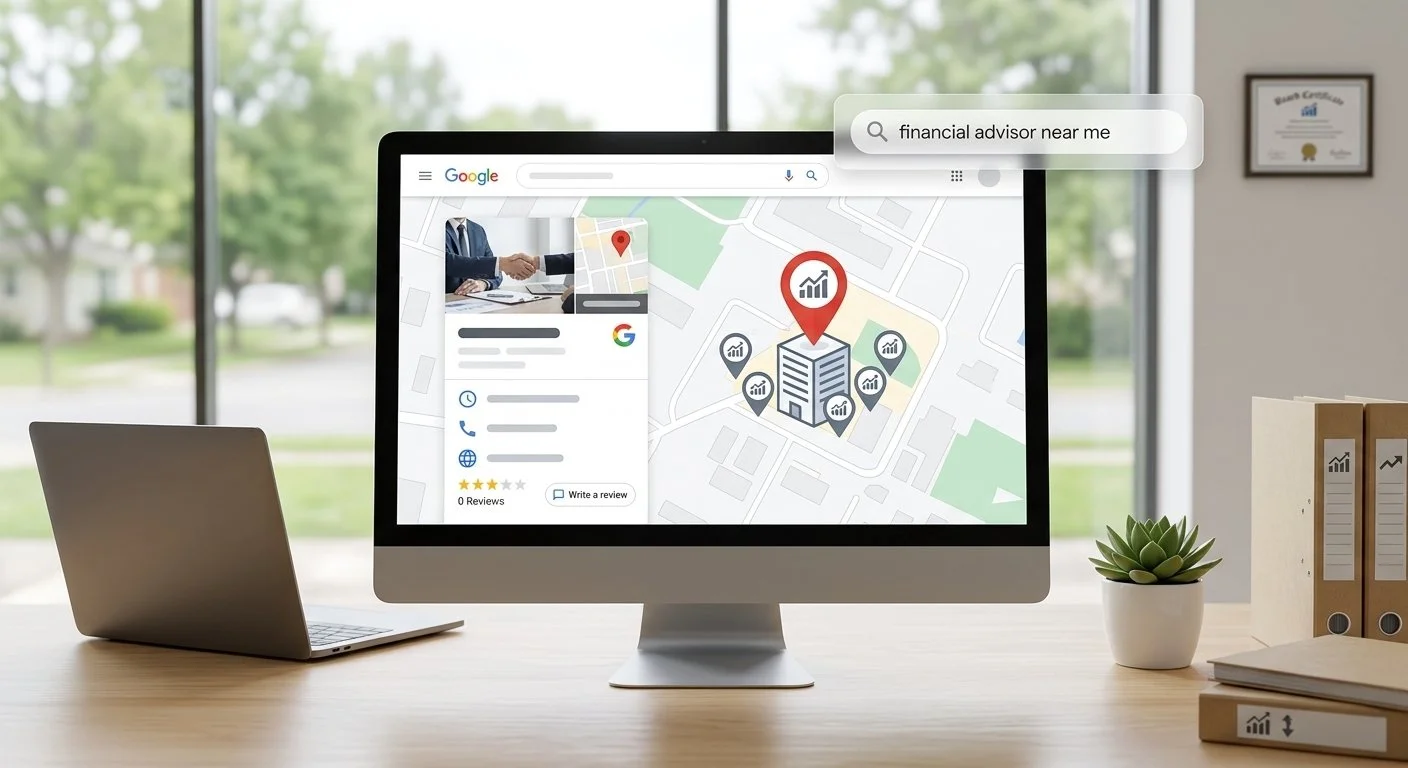
A prospect who searches "financial advisor near me" often sees the Local Pack first, the three local businesses Google shows above standard results. Google's Business Profile Help pages say relevance, distance and prominence decide local rankings and that no one can pay for a better position, which makes setting up a Google Business Profile the first local task. Prospects also read before they call: in BrightLocal's 2026 Local Consumer Review Survey of 1,002 U.S. adults, 97% read online reviews for local businesses and 41% always do, up from 29% the year before.
Kitces Research's 2026 study found a revenue acquisition cost of $0.85 per $1 for advisors who only collected Google reviews and $0.13 for advisors who included them on their own websites. That is an association, not proof, and the placement it describes is the one the SEC examined, as the box below shows.
Three facts to match everywhere your firm is listed:
A primary category that fits what you do, approved by your compliance team if your firm requires it.
Your name, address and phone (NAP) identical on your website, your Business Profile, every directory listing and filings such as Form ADV.
A short description worded like your homepage headline.
Do this week: Search your firm's name in Google Maps on your phone. Check that name, address, phone and category match your website word for word. Write down every difference.
SPOKE ARTICLE
Google Business Profile Guide for Financial Advisors
The free Google listing that controls how your practice appears in Google Maps and the Local Pack. It covers verification timelines, the factors that drive local ranking, what changed on profiles in 2026, and a compliance checklist.
Compliance check before you ask for a review
The SEC Marketing Rule (Rule 206(4)-1 under the Investment Advisers Act) sets conditions for testimonials and endorsements: clear and prominent disclosures, advisor oversight and, usually, a written agreement. The SEC has no rule written only for Google reviews, and its Marketing Compliance FAQs, updated January 15, 2026, include no question on online reviews. In its December 16, 2025 risk alert, the SEC Division of Examinations flagged these problems:
The most common testimonial and endorsement deficiency was missing disclosures when the content was published, often on advisors' websites, including sites under alternative business names.
Client reviews copied from third-party sites onto an advisor's own site without clearly and prominently saying they came from current or former clients.
Gift cards given to clients for writing reviews on third-party sites, without an apparent basis to believe the reviewers met the paid-testimonial disclosure requirements.
Third-party ratings used without meeting the requirements, including weak due diligence on the rating's survey, mismatched dates and logos that did not name the rating provider.
The SEC's 2020 adopting release says an advisor can make a third party's statement its own by approving it (adoption) or helping prepare it (entanglement). An unsolicited review is not automatically the advisor's, but selectively deleting or editing reviews can change that. State-registered advisors follow their state's advertising rules. On May 4, 2026, NASAA announced that its members voted to adopt amendments to four model rules on testimonials, endorsements and performance reporting, and they apply only where a state adopts them. Broker-dealer representatives also answer to FINRA's communications rules.
The approval step that slows a review request is the same step that makes a review safe to display. Kitces found the lowest cost for Google reviews, $0.13 per $1 of new revenue, among advisors who displayed them on their own websites, which is the placement the SEC examined. A documented approval process is what lets you use it.
Run client-facing content, including review requests and replies, through your own compliance review before you publish it. This page is education, not legal advice.
ANSWER
What Is the Difference Between GEO and AEO?
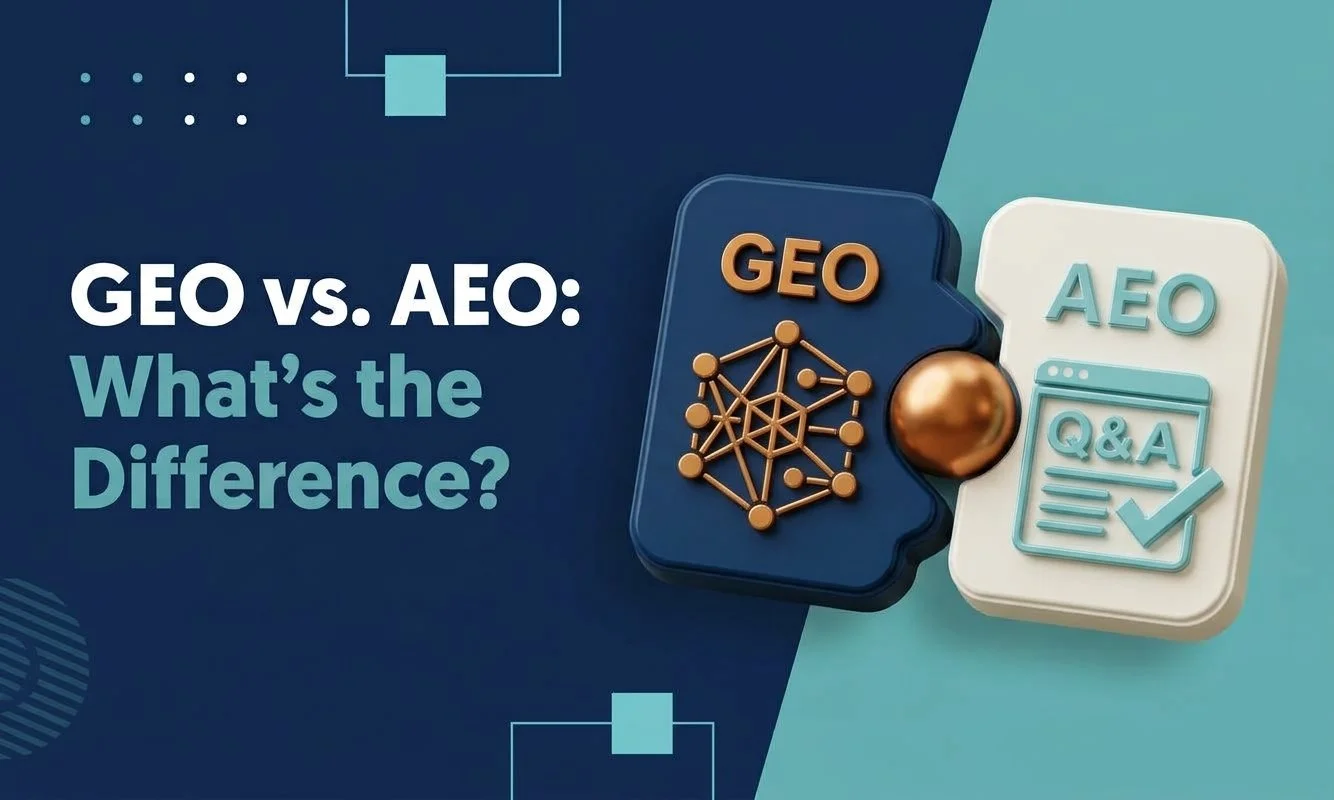
Answer engine optimization (AEO) shapes your pages so search engines can lift a direct answer into a snippet or AI Overview. Generative engine optimization (GEO) gives AI assistants such as ChatGPT and Perplexity clear, sourced statements about your firm to name and quote.
The two terms overlap, which is why advisors mix them up. The 2023 paper that introduced GEO, by Aggarwal and co-authors, reported visibility gains of up to 40% for some methods in its benchmark tests, a best case and not a forecast for any advisor, so the difference between GEO and AEO decides which of your pages to change first. The audience is large: in Pew Research Center's "Americans and AI 2026" survey of 5,119 U.S. adults, 49% said they use AI chatbots.
Definitions vary, so check what a number covers. Kitces Research defines AEO as "optimizing content to appear in AI-powered search platforms", which covers both terms, so its AEO figures include GEO work.
Both start with the same answer-first page, but they are measured in different places. AEO work shows up in Search Console impressions and clicks. GEO work shows up in a log of what assistants say. Choose the measure you will actually do each month, and start with answer-first pages (AEO) before you add plain-text, sourced statements and a monthly log of what assistants say (GEO).
Do this week: Pick one page. Read its first two sentences and ask whether they answer the heading's question on their own. That is the AEO test. Then ask ChatGPT the question a prospect would ask and note whether your firm appears. That is the GEO test.
SPOKE ARTICLE
AI Search Optimization for Advisors: GEO vs. AEO Explained
GEO gets your content quoted inside tools like ChatGPT and Perplexity, and AEO gets it into featured snippets and AI Overviews. Learn which to start with, five optimization steps, and how to check monthly whether AI names your firm.
How Do Advisors Get Recommended by ChatGPT?
No one can guarantee that ChatGPT names your firm, but you control whether your name, credentials and niche read the same on your own site and on pages you do not own.
AI assistants cite pages that Google does not rank for the same question. Ahrefs' August 2025 study of 15,000 long-tail queries run through ChatGPT, Gemini, Copilot and Perplexity found that on average 12% of cited links ranked in Google's top 10 for the original prompt (Perplexity 28.6%, ChatGPT about 8%), and about 80% ranked nowhere for it, so getting recommended by ChatGPT as an advisor depends on more than your Google rankings. Ahrefs says assistants retrieve pages for several variations of a question, which it calls query fan-out. Third-party pages that describe you, such as directory profiles and getting quoted in the press, belong in the plan. That is my reading of the data, not a finding in it.
Why the surveys disagree
| Survey | Who was asked | What it measured | Result |
|---|---|---|---|
| Wealthtender, 2025 | 500 U.S. adults in households earning over $100,000 who plan to hire an advisor within five years | A plan: where they said they would start | 25% said an AI tool |
| Ficomm Partners with Absolute Engagement, 2026 | 1,000 high-net-worth investors who already work with an advisor (margin of error 3.1%) | Behavior: what they used in their search | Nearly 9% used an AI tool |
The numbers do not conflict. One group is prospects stating a plan and the other is clients reporting what they did, so treat 25% as the direction and nearly 9% as measured use, and recheck both next year.
The article on recommendations lists three fixes:
Write new pages answer-first. Open each page with the direct answer to one question, then add the proof.
Refresh your ten best older posts. Update the numbers, add a visible date and move the answer to the top.
Turn the About page into a proof hub. Full bios, photos, LinkedIn links and press mentions give assistants and prospects the same facts about you.
Do this week: Ask ChatGPT, Gemini and Perplexity: "Who is a good financial advisor for [your niche] in [your city]?" Save each answer with today's date. That is your baseline.
SPOKE ARTICLE
How Do Financial Advisors Get Recommended by ChatGPT and Google AI?
How AI tools decide which advisors to name: real experience, verifiable credentials and trustworthy, answer-first content. It explains what changed in how prospects search and gives three fixes your team can start this week.
Simona's take
"Kitces puts the cost of optimizing for AI search at $3.45 per dollar of new revenue, nearly eight times what SEO costs, and I still would not skip it. I read that number as the price of guessing. Even prospects who came to me by referral looked me up before they called, and some now ask an assistant too. So fix the basics first: your name, credentials and niche, identical everywhere. Then ask ChatGPT who it would suggest. The answer is your to-do list."
Simona Ondrejkova, CFP®, former advisor at Merrill
PROVE
How Do You Measure SEO and AI Search Results?
You measure SEO and AI search results by tracking cost against new revenue for each channel, plus three counts you can pull in one sitting: Search Console clicks, Business Profile actions and a monthly log of what AI assistants say about you.
Cost against new revenue is the measure that settles which channel to fund. Kitces measures each channel by what it costs per dollar of new revenue, and the marketing metrics advisors should track start from the same idea: pair every channel with the clients it produced. When search or an assistant sends visitors who never book, the gap sits on the page they land on, a pattern covered in why advisor marketing isn't converting.
| Tactic | Advisors using it | Marketing cost per $1 of new revenue |
|---|---|---|
| SEO | 32% | $0.45 |
| Third-party review sites | 13% | $0.67 |
| AEO | 10% | $3.45 |
| Typical practice, all tactics | n/a | $0.70 |
Source: Kitces Research, 2026 Advisor Marketing Study. 506 advisors, fielded March 6 to April 13, 2026. Most respondents came from Kitces.com's audience, so the results may not represent every advisor. The study defines AEO as optimizing content to appear in AI-powered search platforms and included it for the first time in 2026.
Search Console shows impressions and clicks for each page. Your Business Profile performance page shows calls, direction requests and website clicks. Search Console covers Google Search only, so add "how did you hear about us" to your intake form to catch the rest.
When one number moves, this table points to the first thing to check:
| If this moves | Check this first |
|---|---|
| Search Console impressions flat or falling | Whether the pages are indexed, and whether each opens with a direct answer to one question |
| Impressions up, clicks flat | Title tags, and whether an AI Overview now sits above you (clicks fall when a summary shows) |
| Clicks up, inquiries flat | The page the visitor lands on: the call to action and the booking step |
| Your firm is missing from the monthly assistant log | Whether your name, credentials and niche read the same on your site, LinkedIn and directory profiles |
Change one thing at a time and give it a full quarter before you judge it.
Do this week: Open Search Console and your Business Profile performance page. Copy the last 28 days of clicks, calls and direction requests into one sheet, and add a column for where each new client first heard of you. Review it on the same day each month.
All Articles in This Guide


Not sure where you show up today?
Checking all four parts alone takes time. If you want a second set of eyes on where you are visible today and where you are not, book a visibility call with Simona.
FAQ: Financial Advisor SEO and AI Search
-
Yes. Google's documentation says the same SEO best practices apply to AI Overviews and AI Mode, with no additional requirements. In Kitces Research's 2026 study, 32% of advisors used SEO and it cost $0.45 per $1 of new revenue. The change is in clicks: Pew Research Center found that in March 2025 browsing, people clicked a traditional result in 8% of visits when an AI summary appeared, against 15% without one.
-
SEO earns your pages a place in search results. AEO shapes those pages so search engines can lift a direct answer into a snippet, People Also Ask box or AI Overview. They share one foundation, so the same answer-first page serves both.
-
It depends on your registration and your firm's compliance policy, so get approval before you send a request. The SEC's Marketing Compliance FAQs, updated January 15, 2026, include no question on online reviews. In its December 16, 2025 risk alert, SEC examiners flagged gift cards given for reviews and client reviews copied onto advisor websites without clear disclosures. State-registered advisors follow their state's rules.
-
Some do, and the share depends on who you ask. In Wealthtender's 2025 survey of 500 U.S. adults in households earning over $100,000 who plan to hire an advisor, 25% said they would start with an AI tool. In Ficomm Partners' 2026 survey of 1,000 high-net-worth investors who already work with an advisor, nearly 9% had used one. The first number is a plan from prospects and the second is behavior from clients.
-
No one can guarantee a recommendation. Ahrefs found in 2025 that most pages AI assistants cite do not rank in Google's top 10 for the original question, so the work is to make your name, credentials and niche read the same on your site, your profiles and any press or directory pages that mention you. Start by asking ChatGPT, Gemini and Perplexity who they would suggest for your niche and city, and save the answers as a baseline.
Simona Ondrejkova, CFP®, spent about eight years as a financial advisor at Merrill and now leads marketing strategy for advisors and RIAs as founder of The Advisor's CMO. Her tip: write your bio so a stranger could repeat it in one sentence. If you cannot say who you serve and what you do for them, neither can Google or ChatGPT.
More Guides
PILLAR 1
Marketing Strategy & Positioning
Who you serve, how you plan, and how you measure it.
PILLAR 3
What to publish, and where to publish it.
PILLAR 4
Turning attention into conversations and clients.